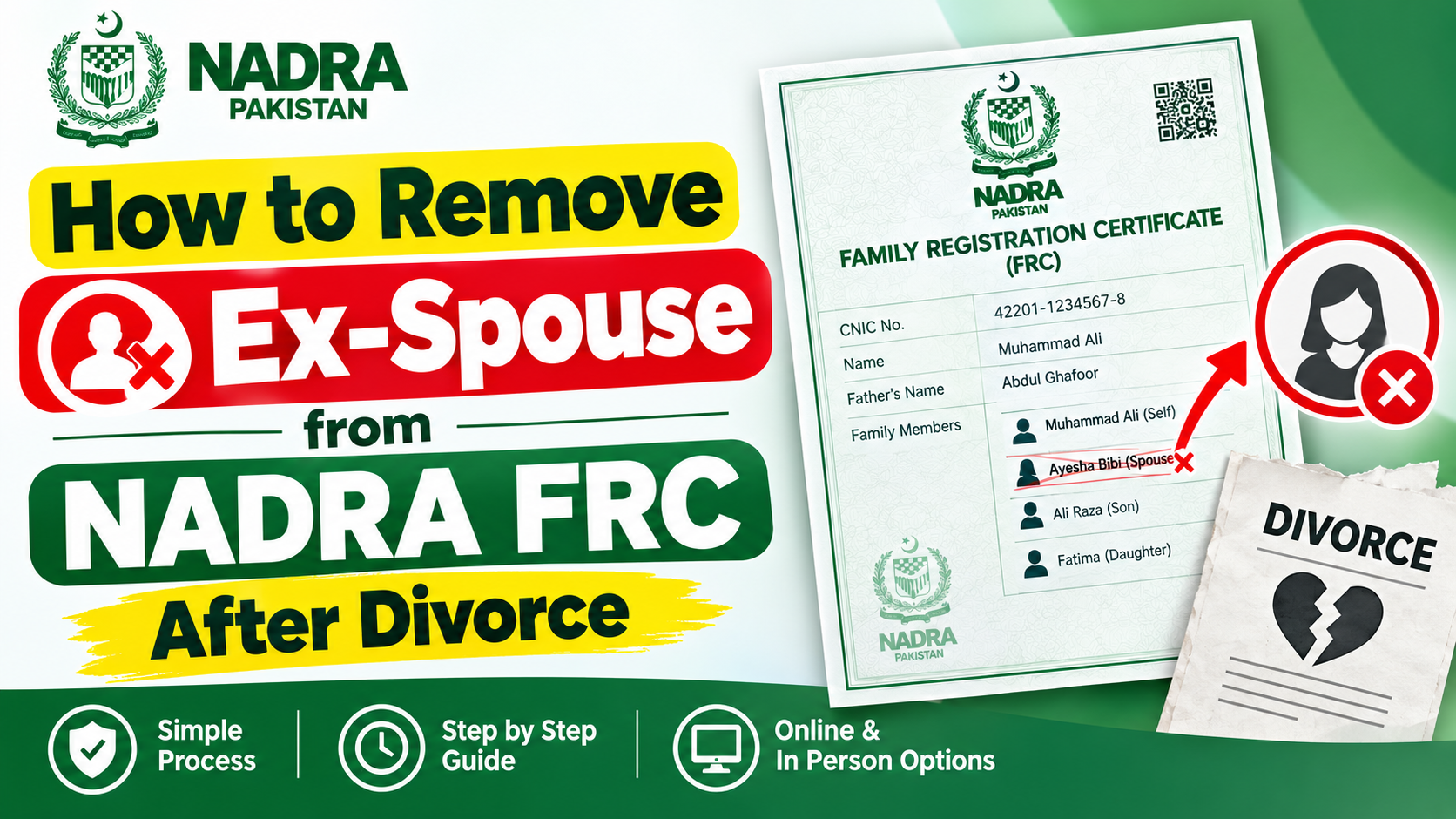
To remove an ex-spouse from your NADRA Family Registration Certificate (FRC) after divorce, you need to submit your divorce decree or registered Khula/Talaq documents, your CNIC, and a modification form to your nearest NADRA Registration Center. NADRA will update your family tree record to reflect your current marital status, which typically takes a few working days to a few weeks depending on the center and case complexity.
Getting divorced in Pakistan involves more than just legal paperwork between you and your former spouse. Your Family Registration Certificate, issued by the National Database and Registration Authority (NADRA), still lists your ex-spouse as part of your family record until you take action to update it. Leaving this unchanged can create complications down the line, whether you’re applying for a new CNIC, processing a passport, or handling inheritance matters for your children.
This guide walks you through the exact steps to remove your ex-spouse’s name from your FRC, the documents you’ll need, and common issues people run into during the process.
What is a NADRA Family Registration Certificate?
A Family Registration Certificate is an official document that outlines your family tree as recorded in NADRA’s database. It lists your parents, spouse, and children, and it’s commonly required for passport applications, visa processing, inheritance claims, and various legal proceedings.
Because your FRC reflects your family status at a point in time, any major life event, such as marriage, divorce, or the birth of a child, requires an update to keep the record accurate.
Why should you update your FRC after divorce?
Once a divorce becomes final, your FRC should reflect your current marital status. An outdated record listing your ex-spouse can cause problems in several scenarios:
- Passport and visa applications, where family details are cross-checked against your FRC.
- Remarriage, since some NADRA offices will flag inconsistencies if your previous marriage isn’t officially closed out in the system.
- Inheritance and custody matters, where an accurate family tree is often required as supporting documentation.
- Children’s records, since their family tree may also need updates if custody arrangements have changed.
Updating your FRC promptly helps you avoid delays or rejected applications later when you least expect them.
What documents do you need to remove an ex-spouse from your FRC?
Before visiting a NADRA center, gather the following:
- Original CNIC (Computerized National Identity Card)
- Divorce certificate or decree, issued by the Union Council (for Khula or Talaq cases, this is typically the registered divorce certificate following the 90-day iddat period)
- Nikah Nama, if requested, to confirm the original marital record
- Children’s B-Forms or CNICs, if applicable, especially if custody details need to be updated
- NADRA modification form (Form available at the registration center or online through NADRA’s website)
Having certified copies rather than originals-only paperwork can speed up the process, since NADRA will often retain a copy for their records.
How do you submit a request to update your FRC?
Step 1: Visit your nearest NADRA Registration Center
While some NADRA services are available online through the NADRA Nadra Nica app or Pehchan portal, family tree modifications involving divorce typically require an in-person visit, since original documents need to be verified.
Step 2: Request a Family Tree Modification Form
Ask the counter staff for the form specific to family record updates. You’ll fill in your CNIC number and indicate that you’re requesting removal of a spouse due to divorce.
Step 3: Submit your divorce documentation
Provide your divorce certificate along with your CNIC and any other supporting documents requested. NADRA staff will verify these against their internal records before processing the update.
Step 4: Biometric verification
You’ll likely need to complete a biometric verification (fingerprint scan) to confirm your identity before the modification request is processed.
Step 5: Pay the applicable fee
NADRA charges a nominal fee for family tree modifications. Fees vary depending on whether you request urgent (executive) or normal processing, so confirm current rates at the counter or on NADRA’s official website before your visit.
Step 6: Collect your updated FRC
Once processed, you can either collect your updated Family Registration Certificate in person or, in some cases, have it delivered depending on the service tier you selected.
How long does it take to update your FRC after divorce?
Processing times vary by NADRA center and case complexity. Normal processing can take a few weeks, while executive or urgent processing (at an additional fee) can reduce this to a few working days. If your case involves disputed custody or incomplete divorce documentation, expect additional delays while NADRA verifies the paperwork.
What if your ex-spouse’s name still appears after submission?
If your FRC still lists your ex-spouse after the standard processing window has passed, follow up directly with the NADRA center where you submitted your request. Bring your receipt or tracking number, since this will let staff pull up your case status quickly. In some cases, additional verification from the Union Council may be required if there’s a discrepancy between their records and NADRA’s database.
Do you need a lawyer to remove your ex-spouse from your FRC?
In most straightforward cases, a lawyer isn’t necessary. The process is administrative rather than judicial, and NADRA staff can guide you through the paperwork. However, if your divorce involved contested custody, property disputes, or incomplete documentation from the Union Council, consulting a family lawyer can help ensure your divorce decree is properly registered before you attempt the NADRA update.
Keep your records accurate for a smoother future
Updating your Family Registration Certificate after divorce isn’t just a formality. It’s a safeguard that keeps your official records aligned with your current life, which matters the next time you apply for a passport, process a visa, or handle matters involving your children. Gather your documents ahead of time, visit your nearest NADRA center, and follow up if your updated record doesn’t appear within the expected timeframe. Taking care of this step now saves you from scrambling to fix outdated paperwork later.
Frequently Asked Questions
Can I update my NADRA FRC online after divorce?
Most family tree modifications involving divorce require an in-person visit to a NADRA Registration Center, since original documents need physical verification. Some preliminary steps may be available through NADRA’s online portal, but final processing typically happens at a center.
What happens if I don’t update my FRC after divorce?
Your family record will continue listing your ex-spouse, which can cause delays or rejections when applying for passports, visas, or other documents that cross-reference your family tree.
Is there a deadline to remove an ex-spouse from my FRC?
NADRA doesn’t enforce a strict deadline, but updating your record promptly after your divorce is finalized helps avoid complications with future applications or remarriage.
Do my children’s records change when I update my FRC?
If custody arrangements changed as part of the divorce, your children’s family tree records may also need separate updates. Bring their B-Forms or CNICs when you visit NADRA to address this at the same time.
How much does it cost to update a Family Registration Certificate?
Fees vary depending on processing speed (normal versus urgent/executive) and are subject to change. Confirm current rates directly with NADRA before your visit.